
When Solzhenitsyn Raped
A poem of repentance by the Nobel Prize winner

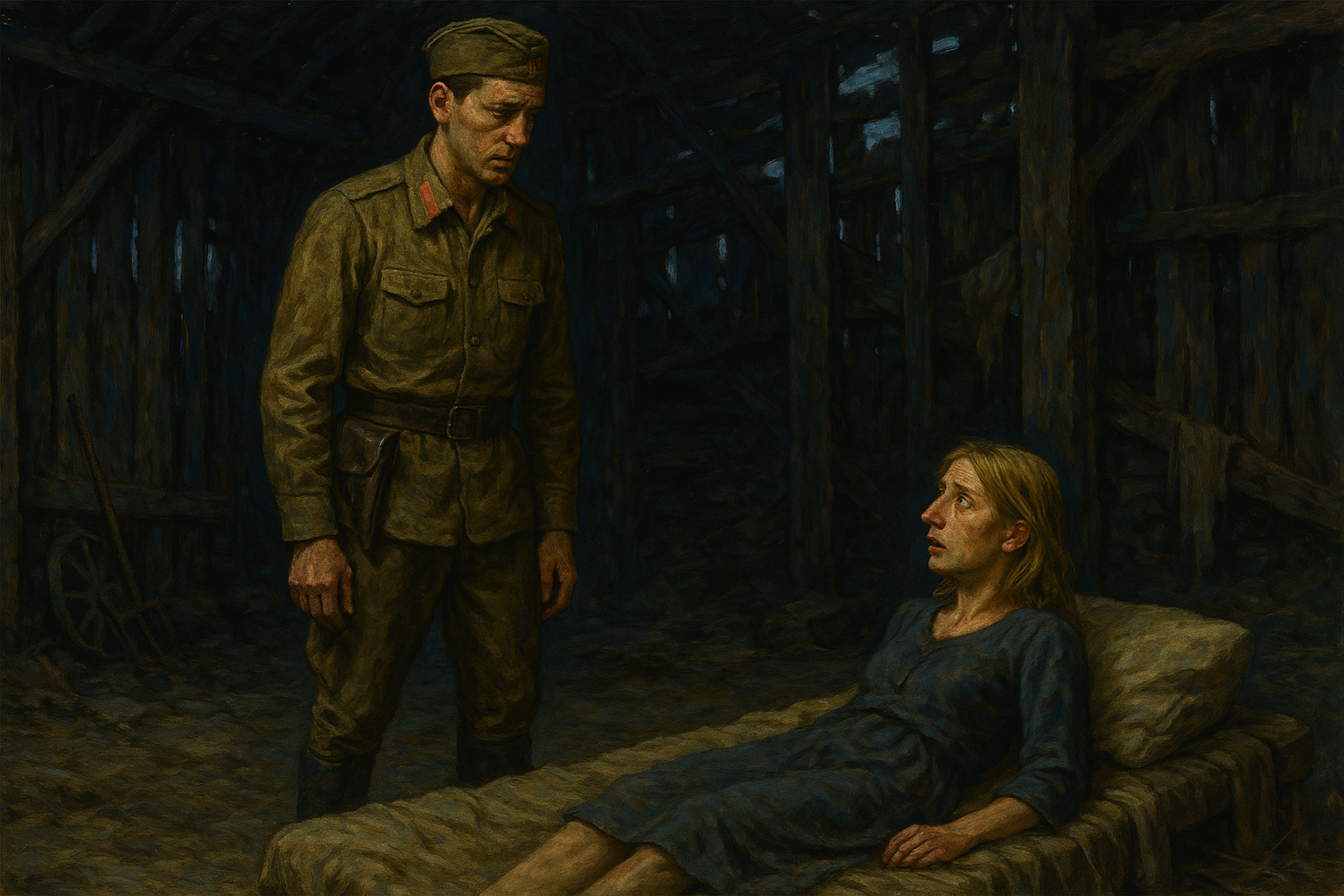
The following is a part of an autobiographical poem (“The Way”) by the self-actualized person and Nobel Prize winner, Aleksandr Solzhenitsyn. It is the confession of a rape he committed while an artillery captain in the Soviet army during its final invasion of Nazi Germany in World War Two.
Solzhenitsyn published this poem, and his even greater autobiographical epic The Gulag Archipelago, partly to model by his own example the radically honest act of “repentance” of one’s past sins. The whole nation of Russia, he firmly believed, needed to undergo this type of repentence, as a way to purify the consciences of its citizens from the mass murders and other atrocities that were committed under its Soviet era of totalitarian Communism. The “great misfortune,” he said some years after the fall of the Soviet government, “is that our society did not cleanse itself spiritually: nobody in Russia ever repented. Communism remains in our hearts, in our souls, in our minds.”1
I personally translated this part of the poem, from the original Russian, back when I was writing my biography of Solzhenitsyn, On Rotting Prison Straw, where a much shorter excerpt of it appears. I thought I would post my full translation of it here, to make available a detailed and fascinating glimpse for the non-Russian reader into the life of one of the most influential figures in recent world history.
The poem in its original Russian, and my further comments on the translation, can be found at the bottom of this post.2
The Way, by Aleksandr Solzhenitsyn (Chapter 9)
My orderly, in the tone of voice of giving a report,
But in a sly, furtive manner of speaking,
Reported to me that he’d set up our artillery battery in its position,
But, out of the pity of his heart, let five [German] families remain in a nearby house.
If this didn’t suit me, however, he could chase them out at once.
For some reason, then, in anxiety, my heart shuddered in my chest.
Not letting it show on my face, I asked him in an uncaring tone,
“Women?”
“Nothing but.”
“Young?”
Looking at me from the corner of his eye, even though my question was unusual, he told me with reassurance:
“Exactly what’s needed… Well, I don’t know about, erm, their faces…”
That is why I love you, Hmelkov! You can read my thoughts at a glance.
And he had already formed a plan:
“I, Captain sir…”
To formulate it in words would’ve been difficult for me
I would’ve probably resumed silence and taken up a book
“…reckon that, in the house, it’s quite populated.
But there’s a barn in the yard, did you see?
And there are cows in the wheat fields nearby.
Two minutes, and it’ll be done.
I’ll bring any one of them to you
for… for milking.
Just simply, take a look and find the one you want.
And tell me with a quick nod.”
Of course. There can be no rest.
I rap the table gently:
“Only the two of us will know about this, and nobody else ever.”
Alright! I’m up.
“Let’s go Vasilik. But let’s go quick, where are they? Lead the way.”
We step outside, circle around, and are at the doorstep.
“You will understand which I want. Look for my signal.”
Steam and the wet mist of soap bubbles.
Hot irons and the burning smell from the ironing board.
Two beds, a table, a trough.
My god, how many of them are stuffed in here.
Can’t even walk through without brushing against them.
Grandmas, mamas, nannies, children.
All of them of different sorts and different heights.
From infants to adolescents,
all try to squeeze out of my way as I walk by.
Some look away from me, some watch me from the corners of their eyes.
Some don’t take their eyes off my face, an alien from a different planet.
The shouts, conversation, and hubbub has all turned to silence.
Only my overcoat rustles as I step.
As for Hmelkov, he looks completely at home here,
Leaning his body carelessly on the doorway, half standing, half sitting.
How awkward, how comical I appear.
I look over the faces of the women,
But I don’t find any that appeal to me.
Some ran away into the cold and the forest, others are hiding somewhere nearby.
For what did I get myself into this?.
The hell with it. “Wha-what is your name?” [I ask in German]
An overly skinny blonde, wringing wet laundry out over the bathtub,
slightly adjusts her headscarf, and answers me: “Anna.”
Let’s see… her face… her figure… yeah…
She’s certainly no movie star. No, not a movie star…
She could certainly use being a few years younger,
and a fuller figure, there… and there…
And her nose, for that matter, is a bit large.
But then, I’m no forest king myself.
Fine, the hell with it. It could be better, it could be worse.
I just have to get out of this house already!
Hastily muttering something under my breath,
I quickly escaped outside.
Behind me followed my orderly.
On the doorstep, he said to me privately:
“All understood. You’ll go to the barn?”
“I – there, yes, just don’t…
it’ll be awkward if… just wait a little while beforehand.”
“Don’t you worry! I’ll handle it! I’m very politic.
Just leave it to me. Go!”
Cold and lifeless, this barn. Cluttered. Gloomy. Unclean.
The wooden chests have been ransacked.
The floor is covered in dirt and dust.
The air has a sharp smell of mothballs.
A sewing machine lays on its side,
from the top drawer of a cabinet, spill out an assortment of old clothes.
What a junkheap! – what must I do to make this workable?
Looking around, I found a pillow on the dusty floor,
a stiff bedframe, and a mattress, that had been left in the corner by someone.
Squeamishly, I picked it all up, and carried it onto the bedframe.
Life brings you the chalice, drink it [to the bottom]!
And don’t ask how much it costs.
The hoarfrost on the barn walls has almost entirely melted from my breathing.
Then I see, in that same headscarf,
with only an extra shawl around her shoulders,
with a galvanized [metal] bucket in her hand,
in a touchingly quiet way, Anna moving through the yard.
Two steps behind, stepping after her brazenly,
like a loyal, oath-sworn warrior,
walks my orderly, in the role of a convoy.
He looked behind him a couple times,
to make sure no one was watching us from the house.
“Not there, you hear me, frau!
Not there! Go to the right!”
In that same brief glance, I saw the mournful expression on her face.
She looked around. Had she understood? And walked over to my hideout.
She opened the door, and on the threshold—was I.
And in surprise, her lip trembled,
as if she thought it a mistake, that I was there.
With an apologetic smile, she tried to excuse herself before me,
in case I concluded that she had suspected me of ill intentions.
Standing there, she still held the metal bucket.
And her white, checkered shawl, was slipping slightly off her shoulders.
My ability of German speech, I forgot in a dumb stupor,
and for some reason, I took her shawl, and pulled it up to cover her shoulders.
From her hands, not yet cooled down from the laundry, a light steam was rising.
Undecidedly asking, she stepped back towards the threshold.
I took a step to that same threshold, and slammed shut the door that was half open.
Sentenced already to my actions, I then ordered her, without looking:
“Come!
Without ardor, without quivers in my taught muscles,
I stood my back turned to the pauper’s mattress, and I heard that she was – “ready.”
Coming uncustomary close, much too close, to her pale blue eyes,
I told her in late arriving words, I myself said it:
“Oh, how base!”
And from the headboard, with sunken forehead,
Anna replied with a quiet voice:
“Please, just don’t kill me!”
“Ah, do not fear, if that is what—”
Oh… on my conscience, there now lies the burden of another soul.
* * *
Oh, where are you, the lamplight of my transparent childhood?
The fire glistening off golden icons, the silver draped around the Christmas pine?
Who is it but a murdered and a rapist, who has now taken up this pen?
Tempted by power over obedient masses,
Having walked down a path paved with shackles,
Equally haven’t I seen pure black devils,
Nor hearts clear as crystal,
Between armies, gravestones, and sects they draw,
That line which separates good from evil,
But it—it passes through the heart of each person
—that line of division.
I come forth to repent toward the heavens,
Before the frigid spite of humanity:
Friends! Is it happiness that you seek? – know that happiness is ruthless.
Or it is victory that you are after? – for there is none that isn’t evil.
***

The above article is a fully translated section of a poem that was partially quoted in the climactic scene of my biography of Solzhenitsyn, On Rotting Prison Staw: The Self-Actualization of Aleksandr Solzhenitsyn.
https://www.christianitytoday.com/1994/08/russian-call-to-repentance/
The original poem was written in rhyming verse, between 1948 and 1952, while Solzhenitsyn was encarcerated in a forced labor camp. The above excerpt was from Chapter 9, subtitled Prussian Nights (pages 108-111 in the published version). The complete Russian poem, read by the author himself, can be found below (the timestamp begins right at the start of my above translation):
There is another English translation of this poem by the historian Robert Conquest, which can be found in book form here. His translation, however, tried to preserve the original rhyming structure the poem had in the Russian language, which ended up grossly distorting the content for the sake of the rhyme and adding unneeded confusion rather than clarity. In my translation above, I made no attempt to make the lines rhyme and instead preserved the exact wording and flow of Solzhenitsyn’s own writing. In terms of the message and content of this candidly revealing work, it is—accordingly—the far superior translation.